

 Intellectual Impairments
 Neurological Impairments
 Physical Impairments
 Psychosocial Impairments
 Sensory Impairments
 Manual & Power Wheelchairs
 Scooters
 Seating & Positioning
 Walking Aids
 Patient Hoists & Lifts
 Ramps
Ramps Transfer Boards & Sheets
 Commodes & Toileting Aids
 Grab Bars & Rails
 Shower & Bath Aids
 Accessible Vehicles & Modifications
 Hand Controls & Driving Aids
 Lifts & Hoists
 Healthcare Accessories
 Hospital & Adjustable Beds
 Pressure Relief Mattresses & Cushions
 Adaptive Clothing & Dressing Aids
 Communication & Writing Aids
 Eating, Drinking & Kitchen Aids
 Developmental & Therapy Aids
 Paediatric Wheelchairs & Strollers
 Positioning & Seating for Kids
 Computer & Electronic Aids
 Hearing & Alerting Devices
 Reading, Writing & Printing Aids
 Hobby & Leisure Aids
 Sports Equipment
 Equipment Rental
 Repairs, Servicing & Installation
South Africa’s Accessibility Paradox in 2025 and 2026: High Ambition, Stubborn Barriers, and the Shifting Enforcement Landscape


Introduction
As 2025 draws to a close, South Africa presents a deeply paradoxical picture regarding accessibility for persons with disabilities. On one hand, the government has launched sophisticated universal design plans and publicly committed to ambitious employment targets. On the other, official data suggests that representation of people with disabilities in the workforce remains stuck at around 1.3 percent, and ministerial statements acknowledge that unemployment in this demographic exceeds 80 percent in some regions.
This article examines the current state of both physical and digital accessibility in South Africa during 2025 and early 2026. It analyses pockets of genuine progress, persistent structural failures, and the specific laws now carrying enforceable penalties for non-compliance.
Part One: Physical Accessibility. A City-Level Blueprint versus National Paralysis
The most concrete development in physical accessibility for this period is the City of Johannesburg’s Universal Design Access Plan, operational from January 2025 to June 2026. Implemented by the Johannesburg Development Agency, this plan mandates that all aspects of public transport, including Rea Vaya, Metrobus, Putco, signage, stations, vehicles, and even digital platforms, be retrofitted according to universal design principles. The Johannesburg Development Agency explicitly states that accessibility must be “built in, not added on,” and frames mobility as a fundamental constitutional right.
However, this remains an isolated municipal intervention. Simultaneously, Minister Sindisiwe Chikunga, speaking at the launch of Disability Rights Awareness Month in November 2025, painted a starkly different picture of the national landscape. She noted that “too many schools still operate in buildings never designed for accessibility,” that assistive devices remain scarce, and that children with disabilities still struggle to enter classrooms with dignity. This disconnects between a progressive metropolitan transport plan and the reality of inaccessible public infrastructure elsewhere captures the uneven geography of accessibility in 2025 and 2026.
Furthermore, in December 2025, the Minister acknowledged that many South Africans with disabilities still face “inaccessible buildings and transport” and “services that do not accommodate different needs.” The persistence of these barriers, 30 years into democracy, underscores that while policy frameworks exist, their implementation remains fragmented.

Part Two: Online Accessibility. The WCAG 2.2 Mandate
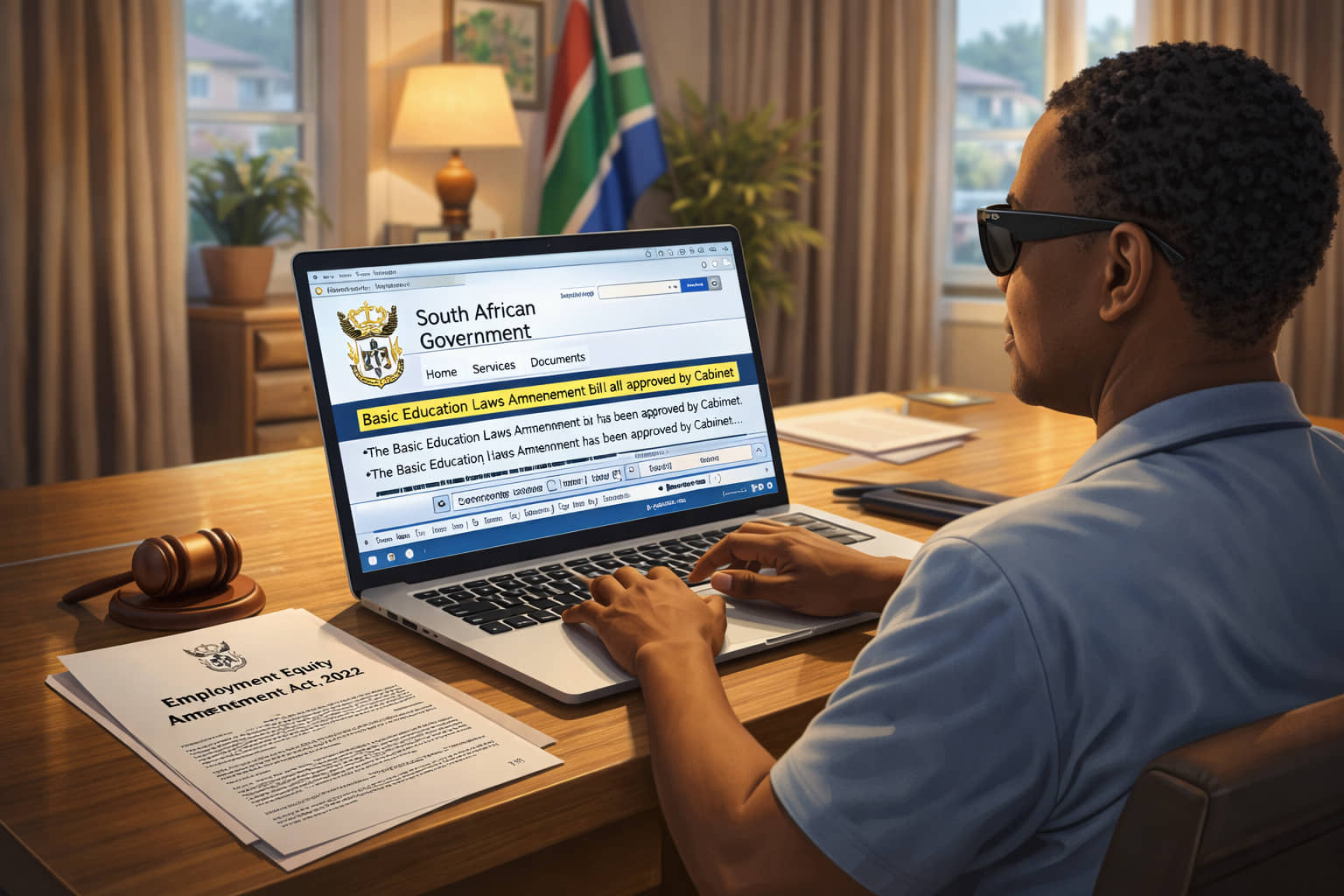
In the digital sphere, 2025 marked a significant technical shift. The South African Government’s official web guidelines now mandate that all government departments conform to at least Level A of the Web Content Accessibility Guidelines, version 2.2, as updated in December 2024 and May 2025.
This is not a vague recommendation. The Government Communication and Information System guidelines published this year detail specific technical obligations, including the following requirements.
Text alternatives for all non-text content must be provided. Captions for all prerecorded audio content are required. Full keyboard navigability without traps is mandatory. Colour contrast ratios of at least 4.5 to 1 are specified. Mechanisms to turn off or remap character key shortcuts to avoid accidental activation must be available.
While these rules are currently binding on government departments, they set a powerful precedent for the private sector. The expectation that banking apps, e-commerce sites, and private services should be seamlessly usable by all South Africans, regardless of ability, is now explicitly stated in ministerial speeches. The gap, however, remains between technical standards and actual compliance.
Part Three: The Legal Landscape. New Penalties and Enforceable Targets
The most consequential legal development for 2025 and 2026 is the full commencement of the Employment Equity Amendment Act, 2022, which came into effect on 1 January 2025. This transforms the accessibility landscape because, for the first time, it shifts disability employment targets from voluntary self-regulation to mandatory, sector-specific quotas.
What the law now mandates are as follows.
The Minister of Employment and Labour are empowered to regulate five-year sectoral employment equity targets for persons with disabilities. Designated employers, both public and private, must meet these targets. The goal is to achieve at least 3 percent representation of persons with disabilities across all economic sectors by 2030. For the public service specifically, the government is pursuing a directive to compel all departments to employ people with disabilities, aiming for a 4 percent target immediately, with a long-term goal of 7 percent by 2030.
Penalties for non-compliance are now substantial. Non-compliance with the Employment Equity Amendment Act and its Regulations is no longer a matter of reputational risk. Enforcement is mandated via the Labour Court, with penalties listed in Schedule 1 of the Employment Equity Act.
Furthermore, for workplace adjustments, the Code of Good Practice, enforceable via the Commission for Conciliation, Mediation and Arbitration, imposes strict timelines. Acknowledgment of an accommodation request must occur within five business days. Conclusion of consultations must occur within 30 calendar days. Implementation must occur promptly, usually within a further 30 days.
Failure to provide reasonable accommodation can result in Commission for Conciliation, Mediation and Arbitration or Labour Court proceedings, with remedies including compensation of up to 24 months remuneration.
The Constitutional Challenge
It would be incomplete to discuss 2025 and 2026 without noting the significant legal friction accompanying these new quotas. In July 2025, employer organisations NEASA and Sakeliga launched an urgent legal challenge against the Employment Equity regulations.
Their argument is not against disability inclusion per se, but against the mechanism of the EEA1 form. They contend that forcing employers to classify employees by race and disability, particularly when employees refuse to self-identify, places employers in an “unconstitutional” position reminiscent of Apartheid-era racial classification laws. This challenge, currently unresolved, creates a degree of legal uncertainty regarding how strictly the disability targets can be enforced administratively.
Part Four: Other Applicable Laws for Non-Compliant Parties
Beyond the Employment Equity Act, non-compliant parties face exposure under two other statutes.
The first is the Promotion of Equality and Prevention of Unfair Discrimination Act, 2000. While this Act has existed since 2000, it remains the primary vehicle for disability discrimination complaints regarding access to premises, goods, and services. Equality Courts, designated in every magisterial district, retain jurisdiction over cases where a person with a disability is denied access to a public building, hospital, police station, or private shop. Despite historically low caseloads, only four physical disability complaints in 2010, the legislative tool is readily available.
The second is the Constitution of the Republic of South Africa, 1996. Section 9 prohibits unfair discrimination on the grounds of disability. While not a penal statute in itself, it underpins all litigation and is frequently cited in Labour Court enforcement actions.
The third is the United Nations Convention on the Rights of Persons with Disabilities. South Africa is a signatory. Minister Chikunga has repeatedly cited the Convention as the benchmark against which the forthcoming Disability Rights Bill is being measured. This Bill, currently being finalised, aims to consolidate all disability protections into a single, comprehensive law.
Conclusion: Ambition Meets Enforcement
In 2025 and 2026, South Africa is no longer suffering from a lack of good policy. The City of Johannesburg’s transport plan demonstrates that the technical knowledge for universal design exists. The Government Communication and Information System’s WCAG 2.2 mandate proves that digital accessibility standards are understood. The Employment Equity Amendment Act provides numeric targets and court-enforced penalties.
The challenge now is one of diffusion and political will. While Johannesburg plans barrier-free mobility, national ministers admit that children still cannot enter schools. While the law sets a 3 percent target, actual employment hovers at 1.3 percent.
For non-compliant parties, whether a private employer refusing workplace adjustments, a government department failing its WCAG obligations, or a shopping centre with steps but no ramp, the risk environment has escalated. The Commission for Conciliation, Mediation and Arbitration is empowered to award significant compensation, the Labour Court can levy schedule penalties, and Equality Courts are accessible to individual complainants.
The period of 2025 and 2026 will likely be remembered as the moment when South Africa stopped asking whether accessibility should happen, and started litigating why it has not happened.


